
Beyond German Grammar: A Conversation with Sina Schmelter


In my previous article, I shared how learning the German language became one of the most transformative experiences of my life. What started as a practical necessity for moving to Germany eventually changed the way I approached uncertainty, learning, and even myself.
Throughout that story, I mentioned someone who played an important role in that journey: Sina Schmelter.
I first met Sina while I was still living in Guadalajara, preparing for my move to Germany. She helped me with my A2 level and conversational German before I relocated, and years later, I reached out to her again as I prepared for my B1 exam.
What always stood out to me wasn’t simply what she taught.
It was how she taught.
Rather than asking me to memorize grammar rules, Sina focused on helping me understand the logic behind the language and, more importantly, how to use it with confidence.
After reflecting on my own experience, I wanted to understand the philosophy behind her approach.
Why do so many people believe German is impossible to learn?
How important is cultural context when learning a language?
What makes professionals struggle, even when they’re highly motivated?
And where does AI fit into language learning today?
I asked Sina those questions and many more.
Here’s our conversation:
Interview with Sina Schmelter
To understand more about effective language learning, I asked Sina about her teaching methods and what professionals should keep in mind when learning German.
What inspired you to specialize in teaching German to non-native speakers?
Perhaps the key reason was my own early positive experience with foreign languages. As a child in Germany, I played soccer, and on my team were two girls from the English military base in my city. They attended an English school and didn’t speak much German, while our coach, on the other hand, didn’t speak much English.
At the time, I had only just started learning English in school, but for some reason, I dared to do what none of my German teammates did, I acted as a bridge between our coach and my English-speaking friends, helping them understand tactical instructions and facilitating communication on and off the field. Through this, I realized that foreign languages don’t just help score more goals, they open up opportunities in every aspect of life.
What are the biggest misconceptions professionals have about learning German?
The biggest misconception? That German is a “difficult” language.
Fear of German grammar is something I can debunk for both professionals and general learners.
Like any language, German has complex aspects, but also surprisingly simple ones. One of the easiest features is verb tenses. In English, I need to distinguish between I went, have gone, was going, and have been going, whereas in German, a single phrase like 'ich bin gegangen' can often translate them all.
Another important factor is that what feels “difficult” or “easy” in a foreign language depends on your native language. A good language teacher should recognize this and tailor the learning experience accordingly.
A structured approach that builds on familiar linguistic patterns from languages you already know makes the learning process far more intuitive.
Additionally, many professionals underestimate how much of a career boost German can provide. In the future, Germany is likely to remain a key player in the global market.
As Europe’s largest economy, its industries continue to lead in sectors like automotive, technology, and green energy.
Moreover, Germany’s central location in Europe makes it a critical hub for international trade and logistics. Professionals who can speak German will have a distinct advantage in building relationships with German companies, as relying solely on English may not be enough in an increasingly interconnected world.

How do cultural insights enhance language acquisition?
Language and the environment in which I use it are interdependent.
Based on Ludwig Wittgenstein’s often-quoted statement:
“The limits of my language mean the limits of my world...”
and its complementary counterpart...
“The limits of my world mean the limits of my language...”
The relationship between language and environment has long been discussed.
What I can express in a language undoubtedly depends on what I am able to think, suspect, and know about the world.
How the world appears to me depends on my cultural surroundings.
Take the word "Frühstück" (breakfast) as an example: depending on where I come from, a different image forms in my mind.
We can understand that knowledge and experience of what, when, and how breakfast is traditionally had in Germany is crucial to learning what a German means when they say "Frühstück."
And here, another factor comes into play: experience.
If I have already had breakfast in Germany, noticed how it smells, and figured out what I personally like and don’t like, the learning becomes much more intense. I am more motivated, and I learn much more easily.

How do you adjust your teaching for business professionals versus general learners?
I’d rather talk about how I support professionals in their learning, rather than how I teach them. This perspective is important to me because learning is an active process, while being taught is a passive one. Only an active learner makes rapid and lasting progress.

Thus, the learning path is shaped by the learner’s individual characteristics, for example, what he or she wants to achieve, how much time they’re willing to invest, and what skills they already possess.
Characteristics that many professionals share might include, for instance, that German isn’t the first foreign language they’re learning, that they have a high level of education, or that they’re proficient with new technologies. We can then make optimal use of all these skills in the process of learning German.
What’s your advice for professionals struggling with German grammar?
The trick is to realize that grammar itself is never the learning goal. Your goal shouldn't be "I need to learn German grammar today," but rather focus on your specific communication goals. Professionals have the advantage of knowing exactly why they are learning, specifically, the work-related situations in which they’ll need to speak and interact.

For example, if your goal is "I want to present a future forecast to a business partner, comparing likely versus unlikely scenarios," you then look at which tools you need for that. And aha, enter the Konjunktiv II. Suddenly, the intimidating term loses its fear factor because it’s no longer an abstract concept, but a tool that helps you express yourself exactly how you want to.
How do you see AI and technology shaping language learning in the future?
With AI’s rapid advancements, we face both great opportunities and risks. One major risk in language learning is relying on AI too soon, outsourcing essential cognitive work. If learners skip the process of forming their own thoughts and making mistakes, they lose crucial learning opportunities.
Let’s take an A1-level student who is given the assignment to write five sentences about their family. This assignment is invaluable, because just a moment ago, “sister” or “parents” were merely vocabulary words on a list, and now, for the first time, they are “tools” the learner can use to express something about themselves and their own world. At the A1 level, students might say that they have a sister, mention her age, and state where their parents live.
When they complete this task on their own, rather than taking the easy route with AI, they commit the new words to memory so effectively that they will soon be able to use them confidently and permanently in their language. Only then will they soon be able to express more complex thoughts, such as explaining that their sister is retraining for a new career or that their parents have adjusted well to their new lifestyle in retirement.
Nevertheless, when used correctly, AI can be incredibly useful, especially for learning vocabulary.
I especially recommend AI for learning verbs.
Verbs are always particularly important to me when it comes to vocabulary work because they not only have their own meaning but also serve as the building blocks of a sentence, they define the relationship between the other parts of the sentence.
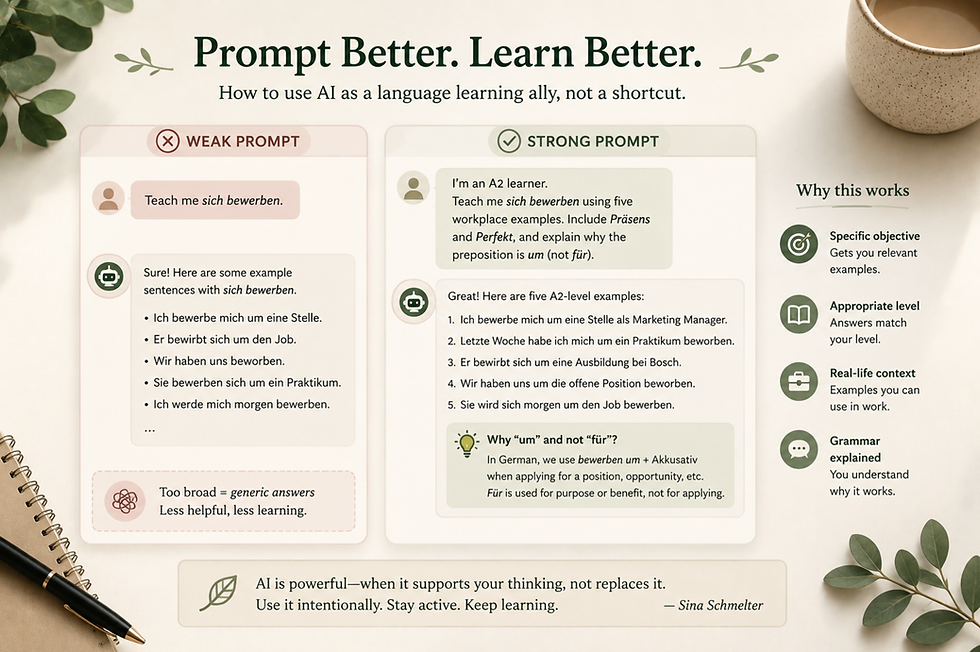
So here’s my suggestion:
Let’s say you want to learn the verb “sich bewerben” (to apply).
In German, this verb comes with its own challenges, it uses a different preposition than in English (“bewerben um” instead of “apply for”), and it has irregular forms in both the present and past tenses. Instead of just asking the AI for "10 example sentences," you should prompt it precisely: ask for sentences that match your specific level and cover those different tenses.
Ultimately, if AI is given the right role, it can be a powerful aid rather than a shortcut that hinders true learning.
What I Took Away from My Conversation with Sina
One thing became clear throughout our conversation: learning German isn’t about memorizing as much grammar as possible.
It’s about understanding how you learn, connecting the language to real-life situations, and giving yourself permission to make mistakes.
For professionals, that also means focusing on the vocabulary, conversations, and cultural context that matter most to their work instead of trying to learn everything at once.
Another idea that resonated with me was Sina’s perspective on AI. Used intentionally, it can be an incredible learning tool. But it shouldn’t replace the thinking, experimentation, and mistakes that make lasting learning possible.
What I appreciate most today is that Sina wasn’t just helping me prepare for language exams. She was teaching me how to become a more independent learner.
If you’re learning the German language for work, relocation, or simply because you’re curious,
I hope this conversation reminds you that fluency isn’t about perfection. It’s about staying curious, practicing consistently, and giving yourself permission to learn one conversation at a time.
Looking for expert guidance in learning German?
Follow Sina Schmelter on LinkedIn and visit her website to learn more about her personalized language training and translation services.
Author

I help businesses turn scattered marketing efforts into clear, scalable content systems. Over the years, I’ve written across industries including SaaS, sustainability, logistics, ecommerce, and professional services, always focusing on content that is strategic, easy to understand, and built to perform.
Co-Author

Sina Schmelter is a conference interpreter and certified translator specializing in German (A), Spanish (B), and English (C). Her expertise in interpretation, translation, and teaching German as a foreign language allows her to provide tailored linguistic solutions for a variety of needs.

Comments